Hi friend,
Despite writing these updates every Monday for nearly two years, they’re somehow taking me longer to write now than ever. I think it’s because I’m finding more interesting things to dive into each week. At least I hope that’s the reason. The other explanation is that my writing ability has begun a slow decline…
Anyway! There’s so much juice in today’s newsletter and I’m excited to get into it.
Flourish and Precise Behavioral raised big rounds. Kaiser committed $10M to the Youth Mental Health Corps. Acadia and Teladoc (BetterHelp) released their Q2 earnings, and Saje — a new multidisciplinary clinic I’m very excited about — opened its doors in Sydney.
There’s more research to review on LLM usage for mental health purposes, AI safety benchmarks and the suitability of single-session interventions. We also have new data on Australia’s social media ban and a fascinating article in Nature Medicine which projects the global economic burden from 2025 to 2050 from depression to be a whopping $12 trillion. Yikes!
OK, let’s get into it!
These weekly emails give you an easy way to stay on top of everything that’s happening and to understand its implications. If you find them valuable, consider joining more than 500 other mental health leaders who are Hemingway Pro members. As a Pro Member, you get access to deep industry insights, access to our private Slack group and invites to our member-only events.
What happened in mental health last week?
Business News:
⏺️ Flourish Health raises $46M to scale intensive care for youth in crisis. Flourish Health has raised $46M in total funding, combining a new $26M Series A led by B Capital, F-Prime Capital and Cherryrock Capital with $20M in previously undisclosed capital. The Virginia-based company sends psychiatrist-led teams into patients' homes to treat young people aged 8 to 26 with severe mental health needs as an alternative to hospital admission. (link)
⏺️ Precise Behavioral raises $14.2M for its behavioural health platform. Precise Behavioral has raised $14.2M, led by A1 Health Ventures. The Los Angeles-based company aims to replace the fragmented mix of vendors hospitals currently rely on for behavioural health support. The company has delivered more than 100,000 patient encounters and is profitable. (link)
⏺️ Kaiser Permanente commits $10M to youth peer support. Kaiser Permanente has pledged $10M to expand the Youth Mental Health Corps, which trains young adults aged 18 to 29 to provide peer support to teenagers in schools and clinics. The investment aims to reach an additional 200,000 young people, building on the programme's work across 16 states since 2024. (link)
⏺️ BetterHelp's shift from cash-pay to payer continues. Teladoc's second-quarter results showed BetterHelp's revenue falling a further 11.6% year on year to $213M. BetterHelp’s cash-pay business continues to decline (even faster than expected) while BetterHelp’s insurance business continues to grow, with users reportedly seeking insurance-covered therapy faster than the company can add provider capacity in certain states and within certain payer networks. BetterHelp generated adjusted EBITDA of $0.5M for the quarter(link)
⏺️ Acadia Healthcare holds revenue flat, continues bed expansion. Acadia Healthcare reported second-quarter revenue of $866m, roughly flat year on year, though underlying growth was 2.8% once one-off state supplemental payments were excluded. The company added more than 300 beds in the first half of the year and remains on track to add up to 600 beds in 2026. Adjusted EBITDA reached $149M for the quarter. (link)
⏺️ UHS beats Q2 estimates, trims full-year profit guidance and confirms Talkspace deal will close in August. Universal Health Services reported second-quarter revenue growth of 8.3% and adjusted earnings per share up 10.1%, beating analyst estimates. Net revenues from UHS' behavioural health care services grew 7.4% on a same-facility basis. The company nonetheless trimmed the top end of its full-year adjusted earnings guidance, citing rising operating costs. UHS management told investors that its $835M acquisition of Talkspace remains on track to close in mid-August and that the deal is intended to reduce the company's exposure to Medicaid cuts by expanding outpatient and virtual behavioural health capacity. (link)
BrainsWay and LifeStance will report second-quarter results in the coming fortnight.
⏺️ Saje opens synchronised-care mental health clinic in Sydney. Saje, founded by Dr. Steve Gluckman, opened its first clinic in Sydney last week. The multidisciplinary clinic pairs psychiatrists, psychologists, GPs with a special interest in mental health, care navigators, and specialist therapists around a patient, whilst also offering advanced therapies. The clinic is a thoughtful innovation in both physical infrastructure, care methodology and technology, worthy of significant interest. (link)
⏺️ Ensora Health launches AI assistant across five therapy disciplines. Ensora Health has launched Ensai, an AI tool embedded in its TheraNest and Fusion platforms that records sessions, drafts clinical notes and answers workflow questions. (link)
⏺️ Greenbrook opens interventional psychiatry centre in Maryland. Greenbrook has opened a National Center of Excellence for Advanced Interventional Psychiatry in Rockville, Maryland, positioning the site as a hub for TMS and other neuromodulation treatments. Greenbrook is owned by Neuronetics, a publicly traded developer of non-invasive treatments for psychiatric disorders. (link)
⏺️ HHS launches behavioural health quality pledge. HHS has launched a behavioural health quality pledge, with Optum signing on as its first private-sector participant. The pledge centres around timely access to high-quality, evidence-based treatment, better measurement and patient-centred, recovery-focused, whole-person care. (link)
⏺️ CMS caps outlier payments for psychiatric hospitals. CMS has finalised its FY2027 payment rule for inpatient psychiatric facilities, including a new cap limiting outlier payments to 20% of a facility's total Medicare payments for facilities with 50 or more stays a year. Overall Medicare payments to these facilities will rise by 2.3%, an estimated $60M increase over 2026. (link)
⏺️ MHRA clarifies rules for ambient voice technology in NHS. The UK's Medicines and Healthcare products Regulatory Agency has confirmed that ambient voice tools used for transcription, summarisation and clinical coding in the NHS are not regulated as medical devices. Tools that support diagnosis or treatment decisions will still fall under the existing device framework. (link)
⏺️ MHRA opens regulatory sandbox for AI medical devices. The MHRA has invited AI-enabled medical device manufacturers and NHS provider organisations to apply for its London Region I regulatory sandbox, which will test the safe deployment of AI technologies in real-world healthcare settings. (link)
⏺️ NHS trust plans £25M in cuts to mental health services. East London Foundation Trust (ELFT) plans to cut a wide range of services and jobs to close a £25M funding gap. At least ten services face redesign, including child and adolescent mental health care, talking therapies and crisis support. (link)
⏺️ Florida advises against psychotropic drugs for children. Florida's health department has issued guidance recommending against prescribing psychotropic medication to children aged 5 to 17 for depression, anxiety and ADHD, aligning with a federal push to curb psychiatric overprescribing. If other states follow, the guidance could accelerate demand for non-pharmacological interventions. (link)
⏺️ VA to test GLP-1 drug for alcohol use disorder. The US Department of Veterans Affairs is launching a clinical trial to test semaglutide, the GLP-1 drug behind Ozempic and Wegovy, as a treatment for alcohol use disorder in veterans. The trial will run over twenty-four weeks, across eighteen sites. (link)
⏺️ Early data show mixed picture on social media age limits. Australia's eSafety Commissioner has published its first assessment of the country's social media age restrictions for under-16s, three months after they took effect. The proportion of children aged under 16 who had a social media account fell from 52% to 42%, while the proportion who reported using social media at all declined only slightly, from 86% to 82%. The report found that many underage children were still able to access platforms because of weak or inconsistent age-verification measures, highlighting ongoing enforcement challenges. Countries that have recently passed similar bans, like the UK and France, will be reading these reports with a close eye. (link)
⏺️ Global heat plans mostly ignore mental health, report finds. United for Global Mental Health, working with Imperial College London, the University of Oxford and Columbia University, examined 143 heat-action plans across 40 countries and 11 global policy documents. They found 57% of plans mention mental health in some form, but only 24% address it meaningfully, such as by naming specific impacts or interventions, and just 14% include concrete protective measures. The report cites Canada's 2021 heat dome, during which people with schizophrenia faced a threefold increase in mortality risk, as an example of the stakes. (link)
Join more than 500 other mental health leaders who are Hemingway Pro members. As a Pro Member, you get access to deep industry insights, access to our private Slack group and invites to our member-only events.
Research News:
⏺️ A quarter of US adults found to use LLMs for mental health in 2024. Researchers surveyed 1,871 US adults between August and October 2024 and found that 24% had used a large language model for mental health support. The paper, published in npj Digital Medicine, found that these users were disproportionately young, male and Black, and reported worse mental health than non-users, citing difficulty accessing traditional treatment and using LLMs because they are free, convenient and available for emotional support, learning therapy skills, and supplementing existing therapy. Based on national usage estimates, the authors calculate that 14 to 18 million US adults may have used LLMs for mental health in 2024. Considering the growth in general LLM usage since 2024, it is likely that this number is higher today. (link)
⏺️ Review highlights major evidence gaps on AI chatbots and youth suicide risk. A review published in npj Digital Medicine concludes that there is currently no evidence that consumer AI chatbots are safe or effective for managing suicide risk in young people. The authors found that most existing studies rely on artificial, single-turn prompts rather than realistic youth conversations, and that chatbot performance deteriorates when suicide risk is expressed indirectly, ambiguously or gradually—patterns that are common in adolescent communication. They call for a youth-focused research agenda to evaluate real-world impacts on suicide risk and help-seeking, improve detection of youth-specific risk, and strengthen connections to trusted adults and crisis services. (link)
⏺️ Review identifies 173 benchmarks used to evaluate LLMs for mental health. Researchers identified 173 publicly available benchmarks used to assess LLMs on mental health tasks and found important limitations in how these evaluations are conducted. Most benchmark data came from social media (39%) or LLM-generated content (32%), while only 12% used clinical interviews and 6% used clinical records; just 2% used hidden test sets to reduce the risk of models training on benchmark answers, only 8% assessed bias, stigma or fairness, and by 2026, 90% of newly developed benchmarks used LLMs to generate, label or evaluate benchmark content. The authors, who have also built a benchmarking tool called mindBench.ai, argue that a benchmark score is not evidence of clinical safety. The paper is a preprint and has not yet been peer-reviewed. If you want to learn more about mental health AI benchmarks, you can read our analysis here. (link)
⏺️ Youths' speech patterns predicted mental health problems up to six years later. Stanford researchers analysed language from stress interviews with 204 children aged 9 to 13 and used it to predict internalising problems such as anxiety and depression years later. The paper published in Nature Mental Health found that linguistic features explained more than twice the variance of traditional, human-rated risk factors, with narratives describing physical violence and social exclusion emerging as markers of risk, and accounts of structured routine activity and healthcare access emerging as protective. (link)
⏺️ Google's SymptomAI outperformed clinicians in a large real-world symptom assessment study. Google Research evaluated five experimental AI symptom checkers in a randomised study of 13,917 participants who described their symptoms through conversational interviews. A panel of clinicians judged SymptomAI's differential diagnoses to be higher quality than those produced by other clinicians in 53.3% of cases, and more likely to include the diagnosis participants later reported receiving from their healthcare provider. The study also found that AI systems which actively asked follow-up questions performed substantially better than standard chatbot-style conversations, although the researchers note that the findings are limited by participants self-reporting their eventual diagnoses and that the system remains an investigational research prototype. The research is not mental health-specific but adds to a broader debate about how AI-driven triage tools should be evaluated. (link)
⏺️ Depression could cost the world $12 trillion by 2050. Researchers built a macroeconomic model using World Bank data and the Global Burden of Disease Study to estimate how depression affects labour force participation, education and work experience across 154 countries. They project a $12 trillion economic burden between 2025 and 2050, equivalent to about 0.46% of annual global GDP and roughly $1,429 per person over the period; including suicide-related deaths attributed to depression raises the estimate to $14 trillion. The United States and China face the largest projected national burdens. This is a fascinating — yet stark — paper that’s well worth rading. (link)
⏺️ Single-session therapy found to be a feasible entry point for youth mental health services. A feasibility study in the Irish Journal of Psychological Medicine examined whether a single therapy session could serve as a lower-barrier first point of contact for young people entering primary care mental health services. The researchers found the model was feasible to implement and acceptable to clinicians and families. Many young people received timely support in a single appointment, with a substantial proportion not requiring ongoing therapy, suggesting the approach could help improve access and reduce waitlists, although the study was not designed to determine whether it improves clinical outcomes compared with standard care. (link)
⏺️ Large study finds only modest agreement between psychiatrists on diagnoses. Researchers asked 1,038 medical doctors working in adult psychiatry across 19 countries to assign ICD-10 diagnoses to standardised clinical case vignettes. Results found only modest diagnostic reliability, with pairs of doctors agreeing on a diagnosis in around 55% of cases. Overall diagnostic accuracy was 66%, with the poorest performance for schizophrenia spectrum disorders, which were commonly misclassified as OCD, personality disorder or bipolar disorder. The authors conclude that diagnostic disagreement reflects systematic differences in clinical interpretation rather than random error, highlighting ongoing challenges in psychiatric diagnosis. (link)
⏺️ SAMHSA survey findings show improvement in youth substance use, major depressive episodes, and suicidal thoughts and behaviours. The 2025 U.S. National Survey on Drug Use and Health found continued declines since 2021 in adolescent alcohol, tobacco and marijuana use, substance use disorders, major depressive episodes, and suicidal thoughts and behaviors, with similar improvements among young adults aged 18–25. However, the survey also found that nearly one in five adolescents reported moderate or severe anxiety symptoms, around 45 million Americans had a substance use disorder, and more than 80% of people who needed substance use treatment did not receive it. (link)
⏺️ Pilot trial suggests psilocybin-assisted therapy may benefit veterans with treatment-resistant PTSD. In the first clinical trial of psilocybin-assisted therapy in U.S. military veterans with severe, treatment-resistant PTSD, twelve participants received two psilocybin sessions alongside psychotherapy. The open-label study found no serious adverse events or increase in suicidal ideation, and clinician-rated PTSD symptoms decreased substantially after one month, with 75% of participants meeting criteria for both treatment response and remission. The authors conclude the therapy appears safe and feasible, but emphasise that larger randomised controlled trials are needed to determine its effectiveness. (link)
That’s all for this week.
Keep fighting the good fight!
Steve Duke
Founder of Hemingway
P.S. If you find these updates valuable, consider becoming a Hemingway Pro Member. As a Pro Member, you will get access to even deeper industry insights and will be invited to join our community of over 500 mental health leaders.
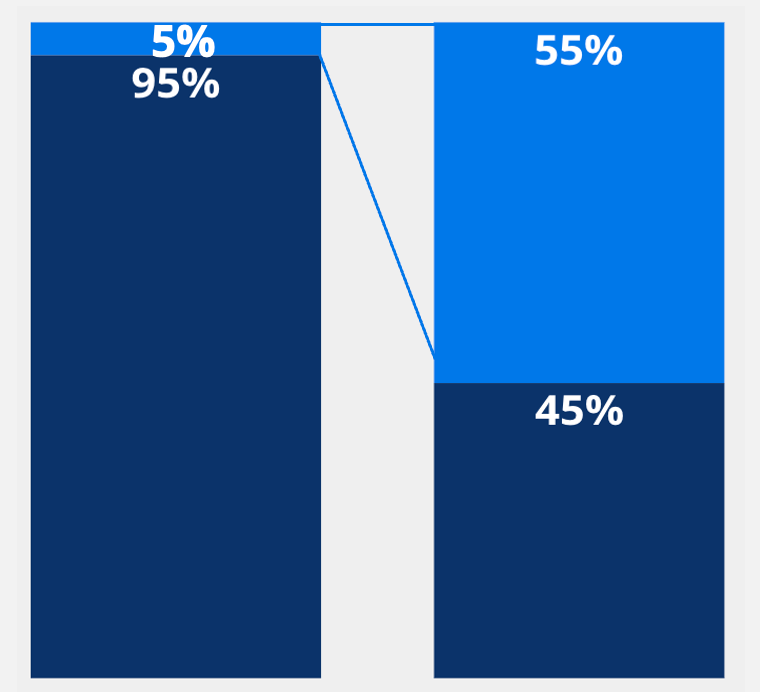
P.P.S. Welcome to Fun with Charts, our weekly mental health chart guessing game, with me, Steve Duke!
We still haven’t had a winner of our most recent chart competition — despite some great guesses! We’re keeping it open for one more week, so send me your ideas. I’ll even give you a little hint… It’s related to funding…