Hi friend,
Headspace announced partnerships with multiple speciality care providers, Headstream announced its 2026 Residency cohort, Bill Ackman is opening a Brain Research Institute, and Otsuka received FDA approval for an interesting new ADHD drug.
It was also a fascinating week on the research front. A Swedish study added to the evidence base for GLP-1s in behavioural health, Medicaid managed care consolidation was found to be associated with worse mental health care, and Kenyan researchers showed that LLMs can automatically monitor therapy session fidelity in multilingual, low-resource settings.
A busy week, but as always, I’m here to tell you everything you need to know about what’s happening in mental health innovation.
So let’s get into it.
These weekly emails give you an easy way to stay on top of everything that’s happening and to understand its implications. If you find them valuable, consider joining the 500 other mental health leaders who are Hemingway Pro members. As a Pro Member, you get access to deep industry insights, access to our private Slack group and invites to our member-only events. You will also be supporting our work.
What happened in mental health last week?
Business News:
⏺️ Mindoula acquired Valera Health and Janus Healthcare Partners in a dual deal. Maryland company, Mindoula, acquired Valera Health, a virtual behavioural health provider with 300+ clinicians, and Janus Healthcare Partners, which brings Collaborative Care Model capabilities into primary care settings. The combined organisation will allow Mindoula to offer integrated behavioural, medical, and social care to health systems and payers. (link)
⏺️ FDA approved SIMTRIYO, a non-stimulant ADHD drug from Otsuka. Otsuka's centanafadine is a once-daily extended-release capsule approved for ADHD in adults and children aged 6 and older weighing at least 20kg. It is the first FDA-approved norepinephrine, dopamine, and serotonin reuptake inhibitor (NDSRI) for ADHD, and has demonstrated low potential for dependence and abuse. (link)
⏺️ Teladoc Health launched Teladoc One, a care model combining multidisciplinary teams with AI support. With Teladoc One, each member is assigned a care team of licensed clinicians, mental health professionals, certified health coaches, and registered dietitians, plus a human care guide who coordinates across in-network providers as well as AI support between visits. Fees will be fully tied to clinical outcomes and total cost of care. Programs will launch with select enterprise clients in September 2026, initially targeting cardiometabolic populations, with broader availability in January 2027. (link)
⏺️ Headspace expanded its specialty care ecosystem via partnerships with Charlie Health, Cortica, Prosper, and Equip. The four partnerships build out a specialty referral network to handle high-acuity cases beyond Headspace's core offering. According to Headspace’s press release, around one-third of cases in its 65,000+ clinician network require this level of intervention. (link)
⏺️ Priory piloted HelloSelf's AI companion tool to support patients between outpatient therapy sessions. Priory operates one of the UK's largest private mental health networks. This pilot with HelloSelf is running at Priory Wellbeing Centre Harley Street and Priory Hospital North London. With patient consent, key elements of therapy sessions are captured, enabling the tool to generate personalised prompts and reflections based on what was discussed. Clinicians retain oversight, with escalation processes in place to pause interactions and alert the clinical team if concerns arise. Outcomes will be tracked using PHQ-9 and GAD-7 measures. Priory (link)
⏺️ Cigna expanded AI-enabled care management to reach 20% more customers with complex or chronic conditions. The programme uses predictive analytics to identify patients earlier and connect them with one of 1,250 clinicians, including behavioural health specialists. Cigna said engaged customers reduced medical costs by an average of $2,000 per year, with 72% of those connected to behavioural health providers achieving clinically meaningful improvement in depression symptoms. The expansion is projected to generate $200M in total savings over three years. (link)
⏺️ MEDITECH embedded validated suicide prevention tools directly into its Expanse EHR. Working with non-profit SPiER, the platform now includes the ASQ screening tool, Columbia Suicide Severity Rating Scale, Stanley-Brown Safety Planning, and the CAMS Framework across inpatient, ambulatory, and ED settings. Real-time surveillance pushes alerts to care teams for at-risk patients, with automated call-back reminders to close gaps at discharge. (link)
⏺️ Headstream announced its 2026 Residency cohort supporting early-stage youth mental health startups. The 2026 cohort has many AI-focused companies, including Circuit Breaker Labs, which stress-tests AI products; MindMode AI, which predicts patient disengagement before dropout; and Flourish Science, an RCT-validated AI app for young people. Luna, Navi and Here Now Health were also among the selected companies. (link)
⏺️ CHAI released a best practice guide and testing framework for AI in healthcare. The Coalition for Health AI's Mental Health Work Group — which includes Headspace, Mental Health America, Spring Health, and Stanford University — produced two new resources. The first is a best practice guide covering product scope, safety guardrails, crisis handling, and user trust for AI products. The second is a living testing and evaluation framework hosted publicly on GitHub. A key finding from the work was that risks of unhealthy attachment and crisis signals often emerge across multiple conversations over time rather than within a single chat, making longitudinal evaluation essential. (link)
⏺️ A federal court struck down a DC law that barred out-of-state therapists from providing teletherapy to DC clients. The US District Court for DC ruled in favour of Elizabeth Brokamp, a Virginia-licensed counsellor who had been blocked from treating DC-based clients online because she was not licensed in the district. The court held that the DC licensing requirement violated the First Amendment as applied to talk therapy, finding that counselling is constitutionally protected speech. (link)
⏺️ Bill Ackman's foundation acquired two Manhattan buildings to create a 700,000 square foot brain research institute. The Ackman Oxman Institute, developed in partnership with Mount Sinai, will bring together researchers working across neurosurgery, genetics, nutrition, rehabilitation, and longevity. (link)
⏺️ UK think-tank report found one in five children has a probable mental health disorder amid a worsening childhood crisis. The Centre for Young Lives' annual State of the Nation report, published today, found more than 1.27 million referrals were made to children's mental health services in 2024-25. Cases where mental health was a factor in social care assessments rose 10% in two years. The report referenced worsening social and economic conditions in the UK, highlighting that 3.5 million children in England live in relative poverty. The report called on the UK’s new Prime Minister, Andy Burnham, to make reducing childhood vulnerability a national mission, warning that incremental change is no longer sufficient. (link)
⏺️ ChatGPT Health launched for all US users, connecting medical records and fitness data. OpenAI rolled out the feature to all signed-in US users, enabling integration with Apple Health and electronic medical records. The platform already handles 300 million health-related queries per week. A California lawsuit filed the same day seeks to block the product, alleging it dispenses dangerous medical advice. (link)
Join more than 500 other mental health leaders who are Hemingway Pro members. As a Pro Member, you get access to deep industry insights, access to our private Slack group and invites to our member-only events.
Research News:
⏺️ Study found LLMs can automatically monitor therapy session fidelity in multilingual, low-resource settings. Researchers in Kenya piloted shamiriAI, an LLM-based tool that monitors how well lay-delivered mental health sessions follow their intended protocol across code-switched Swahili-English audio. The system achieved strong speech recognition performance, opening a pathway to scalable quality assurance for task-sharing programmes in low-resource settings. (link)
⏺️ Suicide-related language found to cluster around three motivational cores that generic LLM scoring fails to detect. Researchers analysed text from Reddit suicide forums, authentic suicide notes, and non-clinical writing, using a model trained on 27 established psychological theories of suicide risk. The highest-risk language consistently centred on three themes: feeling like a burden to others, wanting to escape, and a deeply negative view of oneself. Standard AI models, when asked to rate suicide risk in the same texts, gave crude, undifferentiated scores that missed these distinctions. (link)
⏺️ Study found GPT-4, Grok, and ERNIE produce harmful suicide-related content in most outputs. Researchers gave GPT-4, Grok, and ERNIE 11 suicide-related writing prompts across five styles, including news reports and fiction. Grok responded to 96% of prompts and most frequently included suicide methods and romanticised portrayals. Across all three models, only 16–22% of outputs focused on hope and recovery. (link)
⏺️ Birches Health published one of the largest real-world outcomes datasets for virtual gambling disorder treatment. Birches is a specialist virtual provider offering therapy-based care for gambling disorder. A retrospective cohort study of 1,305 adults using the platform found G-SAS gambling symptom scores fell by an estimated 8.3 points over 12 weeks, with 71.7% achieving clinically meaningful improvement in a median of 14 days. Over half had psychiatric comorbidities. The study was retrospective and uncontrolled. (link)
⏺️ A third of English teenagers found to have encountered self-harm content online in the past month, mostly through algorithm-driven feeds. Bear, Soneson, and Fazel at Oxford analysed 2025 OxWell survey data from 32,102 students aged 11–18. 34.5% reported past-month exposure, and of those exposed, 66.2% encountered the content through algorithmic feed suggestions rather than actively seeking it. Every exposure pathway was associated with higher loneliness, anxiety, and depression; however, the study cannot establish causation. (link)
⏺️ Nature Mental Health study found childhood unpredictability predicts mental health problems that standard ACE screening misses. Glynn, Baram and colleagues added a five-item unpredictability screen to existing ACE screening across 19 California paediatric clinics, collecting data from nearly 30,000 children. Children with a high unpredictability score but zero ACEs had an 11.7-fold higher risk of depression compared with children scoring zero on both. The two screens identified largely different at-risk children, suggesting unpredictability captures a distinct dimension of adversity. (link)
⏺️ Health Affairs study found Medicaid managed care consolidation is associated with worse mental health care for low-income youth. Researchers analysed 2022 national Medicaid claims data and found that managed care organisations owned by large national parent firms had lower mental health screening rates and higher use of emergency department, inpatient, and medication-based care, including psychotropic prescribing without accompanying psychotherapy. Provider composition also varied significantly by firm. The findings raise questions about how consolidation in Medicaid managed care affects the quality and structure of behavioural health services for vulnerable young people. (link)
⏺️ Lancet Psychiatry study found GLP-1 receptor agonists are associated with significantly lower hospitalisation in people with alcohol and substance use disorder. The Swedish study found that GLP-1 drugs including semaglutide were associated with meaningfully lower hospitalisation rates in people with alcohol use disorder and substance use disorder, adding to a rapidly growing body of evidence on GLP-1s and addiction. (link)
⏺️ Meta-analysis found rTMS produces no significant benefit over sham for treatment-resistant schizophrenia. A PRISMA-registered meta-analysis found no statistically significant benefit of rTMS over sham stimulation for global symptoms, negative symptoms, or auditory hallucinations in treatment-resistant schizophrenia. (link)
⏺️ Nature Mental Health commentary argued that gut-brain axis research is systematically excluding the Global South. Valderrama and colleagues argued that for more than two decades, microbiome-gut-brain axis research has transformed understanding of depression, anxiety, and neurodevelopment, but has been built on a narrow slice of global diversity. The authors frame expanding this research not just as an ethical obligation, but as a scientific necessity, outlining multiple ways the field would benefit from greater research activity on the gut-brain axis in the Global South. (link)
That’s all for this week.
Keep fighting the good fight!
Steve Duke
Founder of Hemingway
P.S. If you find these updates valuable, consider becoming a Hemingway Pro Member. As a Pro Member, you will get access to even deeper industry insights and will be invited to join our community of over 500 mental health leaders.
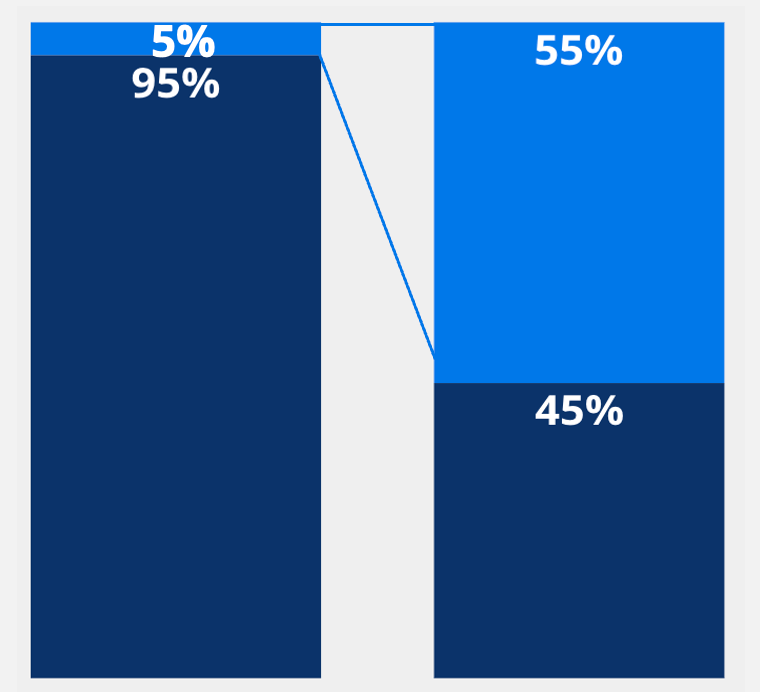
P.P.S. Welcome to Fun with Charts, our weekly mental health chart guessing game, with me, Steve Duke!
There was no winner of last week’s competition, so we’re extending it for one more week. If you want to be crowned Mental Health Nerd of the week and receive a special Hemingway prize, just reply to this email with what you think the graph below represents.