Hi friend,
There were two big deals this week. In the Medicaid software market, Acentra Health bought FEI Systems, and in biopharma, Supernus and Indivior merged.
In other industry news, Lifestance announced very strong Q2 earnings, including rate increases, with the stock price reaching a five-year high. Amae partnered with Google Health on wearables, OpenAI partnered with the APA to make AI safer for youth, and the UK government committed £343M to open 159 new NHS mental health facilities.
On the research front, SIM-VAIL — a new framework for evaluating AI chatbot safety in mental health — was published in Nature Medicine. The voice AI app Sonia released a preprint showing reductions in anxiety scores; dronabinol — a THC-based medication — was found to significantly reduce nightmare severity in PTSD patients; and a working paper with over 12,000 French participants found that nudging people toward daily AI conversations increased loneliness.
Let’s get into it!
These weekly emails give you an easy way to stay on top of everything that’s happening and to understand its implications. If you find them valuable, consider joining more than 500 other mental health leaders who are Hemingway Pro members. As a Pro Member, you get access to deep industry insights, access to our private Slack group and invites to our member-only events.
What happened in mental health last week?
Industry News:
⏺️ Acentra Health bought FEI Systems, adding behavioural health software to its government contracts business. Acentra runs the back-office systems that US state and federal agencies use to administer Medicaid, including checking who qualifies, processing claims and coordinating patient care. FEI Systems makes similar software specifically for long-term care and behavioural health programmes, tools that help caseworkers track and manage support for people with ongoing care needs. The acquisition lets Acentra offer both sets of services to the same government clients under one roof. Financial terms were not disclosed. (link)
⏺️ Supernus and Indivior agreed an all-stock merger to form a $2.2B CNS biopharmaceutical company. Supernus makes medicines for ADHD, Parkinson's disease and other neurological conditions. Indivior makes treatments for opioid addiction, including long-acting injectable medications. The two companies are combining as equals in an all-stock deal, creating a single business with 11 marketed drugs spanning psychiatry, neurology and addiction, and around $2.2B in combined annual revenue. The new company, to be called Supernus, Inc., expects to save $125M a year by merging operations, and the deal is expected to close in the fourth quarter of 2026. (link)
⏺️ LifeStance Health announce strong Q2 earnings. Revenue grew by 26%, versus Q2 2025; positive net income for the quarter was $24 million, and Adjusted EBITDA margin was 15%. Visit volume increased by 19% YoY, driven by network growth and better clinician productivity. Revenue per visit also increased by 6% YoY, suggesting Lifestance are getting improved rates from payers. The company raised its full-year guidance and said it will keep pursuing small tuck-in acquisitions to enter new geographies. Management also announced plans for a $100M share repurchase program. Lifestance’s share price is now at a five-year high, with a market cap of $4.2B.(link)
⏺️ Amae Health partnered with Google Health Enterprise to bring wearable data into psychiatric care. Amae will provide Fitbit devices to patients with serious mental illness, and with patient consent will provide sleep, activity and heart rate variability data to clinicians. The company aims to build a predictive model that combines wearable data with clinical information to assess disease progression. The Google Health partnership is an important step in a broader strategy to collect helpful biomarker data to improve care. (link)
⏺️ Here Now Health expanded its virtual mental healthcare service for foster youth to New Mexico Medicaid. The startup connects Medicaid-covered foster children with clinicians who specialise in child welfare, building on existing operations in Virginia and Missouri. Here Now says it saves caseworkers around five hours per referral by handling eligibility checks and tracking down missing information. The company has raised just over $4M to date and say it has served 250 children. (link)
⏺️ Upheal added AI-drafted insurance billing and an agentic assistant to its EHR. Upheal is an electronic health record platform built for mental health clinicians. It released two new features: insurance billing with AI-drafted denial appeals, and an agentic AI assistant that can handle administrative tasks like scheduling on a therapist's behalf. (link)
⏺️ OpenAI and the American Psychological Association partnered to develop AI safeguards for youth mental health. The partnership will look at how AI tools can help young people in moments of distress, how to make AI design more age-appropriate, and how to give parents, caregivers and clinicians better tools to guide the way young people use AI. (link)
⏺️ The Jed Foundation and YMCA of the USA launched a national partnership on youth mental health. The 18-month programme will bring technical assistance, training and crisis planning to local YMCAs. The Y joins a network of 22 community-based organisations working with JED, that collectively reach 8.5 million young people. (link)
⏺️ The UK government committed £343M to open 159 new NHS mental health facilities. The rollout includes 100 walk-in community mental health centres and 59 dedicated mental health emergency departments, designed to shift care from crisis response to earlier intervention in alignment with the NHS Ten Year Plan. The first sites open this autumn, with a second wave following in March 2027. (link)
⏺️ Mind opened its call for evidence on AI and mental health. The UK charity's year-long Mental Health in the Age of AI Commission is gathering views from people with lived experience, clinicians and technologists on how AI affects help-seeking, safety and inequality in mental health support. The call for evidence runs until November, ahead of an interim report in January 2027. (link)
⏺️ The UK’s MHRA outlined its next steps for regulating AI in digital mental health technology. A review drawing on a 59-person symposium of clinicians, regulators, industry and patient representatives set out plans for a mental-health-specific regulatory sandbox for AI-as-medical-device products, alongside a newly established National Commission into the Regulation of AI in Healthcare tasked with recommending a new UK framework. The review also flagged the difficulty of classifying AI tools that sit between "wellness" and "medical device" status. If you are interested in understanding regulation of Mental Health AI in the UK, you can read our full guide here. (link)
⏺️ A New Mexico court ordered Meta to pay $567M over harms to youth mental health. The ruling found that Instagram and Facebook's design, including endless scrolling and notifications, created a public nuisance and contributed to the state's youth mental health crisis. The order adds to $375M in civil penalties from March and requires Meta to implement usage limits, notification restrictions and AI chatbot safeguards for teen users. The funds will be used for treatment services for young people as well as awareness, prevention and screening services. Meta says it will appeal. (link)
⏺️ New EU rules require AI chatbots and tools to disclose when someone is talking to AI, not a person. The EU AI Act is Europe's overarching law regulating artificial intelligence, and a new set of its requirements took effect on 2 August. Under these rules, any AI system that interacts directly with users, such as a chatbot or mental health app, must make clear that the user is dealing with AI, unless this is already obvious. The rules also cover AI-generated content, emotion-recognition tools and deepfakes. They apply to any company operating in the EU, regardless of where it is based, with non-compliance bringing fines of up to €15M or 3% of global annual turnover. (link)
⏺️ A North Carolina survey found improving mental health among high schoolers, including a sharp drop in suicidal ideation. The 2025 Youth Risk Behavior Survey of 1,692 students found 29.7% said they had felt so sad or hopeless for at least two weeks that they stopped doing their normal activities, down from a high of 43% in 2021. The share of students who said they had seriously considered attempting suicide also fell, from 22.3% in 2021 to 11.4% in 2025. The survey also found a decline in social media use. (link)
Join more than 500 other mental health leaders who are Hemingway Pro members. As a Pro Member, you get access to deep industry insights, access to our private Slack group and invites to our member-only events.
Research News:
⏺️ SIM-VAIL, a framework for evaluating AI chatbot safety in mental health contexts, was published in Nature Medicine. The framework uses adversarial AI red-teaming to simulate clinically realistic conversations with users who have specific psychological vulnerabilities, such as depression, mania, psychosis or OCD, then scores every turn against clinical risk dimensions. Across 810 conversations with nine frontier chatbots and more than 90,000 clinician-validated ratings, the researchers found that risk built up over the course of a conversation and varied by vulnerability. They identified a recurring pattern they call a Vulnerability-Amplifying Interaction Loop, where broadly supportive behaviours like validation become harmful once they reinforce what is sustaining a user's underlying vulnerability. Newer models were safer overall, and correcting a single concerning response early in a conversation was enough to keep the rest of the exchange on a safer path. The researchers say the method allows safeguards to be tested before a product launches, and have released the full dataset through an open explorer tool. (link, explorer tool)
⏺️ A working paper found that nudging people toward daily AI conversations increased loneliness rather than reducing it. Researchers randomised 12,356 French adults to either hold at least one personal conversation a day with a generative AI tool for 28 days, or continue as usual. Treated participants increased their use of AI for personal conversation and reported small but statistically significant rises in loneliness and depressive affect, alongside a decline in life satisfaction. The study has limitations, including the lack of an active control group, and has not been peer reviewed. (link)
⏺️ A preprint found a voice-based AI companion app reduced anxiety symptoms more than digital psychoeducation. Researchers randomised 400 US adults with moderate-to-severe anxiety to either Sonia, a voice-based AI app teaching cognitive behavioural therapy techniques, or a static WHO-derived self-help webpage, for two weeks. The AI group's anxiety scores fell significantly further than the control group's, with 63% dropping below the threshold for elevated symptoms compared with 32% of controls. An automated safety system flagged three cases of acute risk during the trial and directed those participants to crisis resources, a decision researchers later confirmed was appropriate in each case. The study was partly funded by Sonia Health, the app's developer, and two of the four authors work for the company. The paper has not yet been peer-reviewed. (link)
⏺️ A feasibility trial found psilocybin-assisted therapy improved treatment-resistant depression in an NHS setting. Sixty adults with treatment-resistant depression were randomised to a single 25mg dose of psilocybin or placebo alongside psychological support, in the first such trial conducted within UK public healthcare. Depression scores improved significantly more in the psilocybin group at three weeks, an effect sustained at six weeks. (link)
⏺️ A randomised trial found dronabinol significantly reduced PTSD-related nightmares. Researchers gave 171 adults with PTSD either dronabinol, a THC-based medication, or placebo nightly for ten weeks. Nightmare severity fell significantly more in the dronabinol group, and more than a third of those receiving the drug reported their nightmares stopped entirely, compared with 29% on placebo. The drug did not improve overall PTSD severity or depression, suggesting a specific effect on nightmares rather than the wider condition. Adverse events occurred in 78 patients (89.7%) receiving dronabinol and 64 (77.1%) receiving placebo, with (link)
⏺️ A machine learning model predicted first suicide attempts in early adolescents with strong accuracy. Researchers used data from 4,238 US adolescents aged 11 to 12 with no history of suicide attempts, drawn from the Adolescent Brain Cognitive Development Study, to build a model from 87 potential predictors. Of the cohort, 163 (3.8%) went on to report a first suicide attempt within two years. The model achieved an AUC of 0.82, meaning it could correctly distinguish a child who went on to attempt suicide from one who did not 82% of the time, a level considered good discrimination for a clinical prediction tool (a score of 0.5 would be no better than chance, and 1.0 would be a perfect model). The strongest predictors included sex, sexual orientation, negative affect, internalising problems and lifetime suicidal ideation. (link)
That’s all for this week.
Keep fighting the good fight!
Steve Duke
Founder of Hemingway
P.S. If you find these updates valuable, consider becoming a Hemingway Pro Member. As a Pro Member, you will get access to even deeper industry insights and will be invited to join our community of over 500 mental health leaders.
P.P.S. Welcome to Fun with Charts, our weekly mental health chart guessing game, with me, Steve Duke!
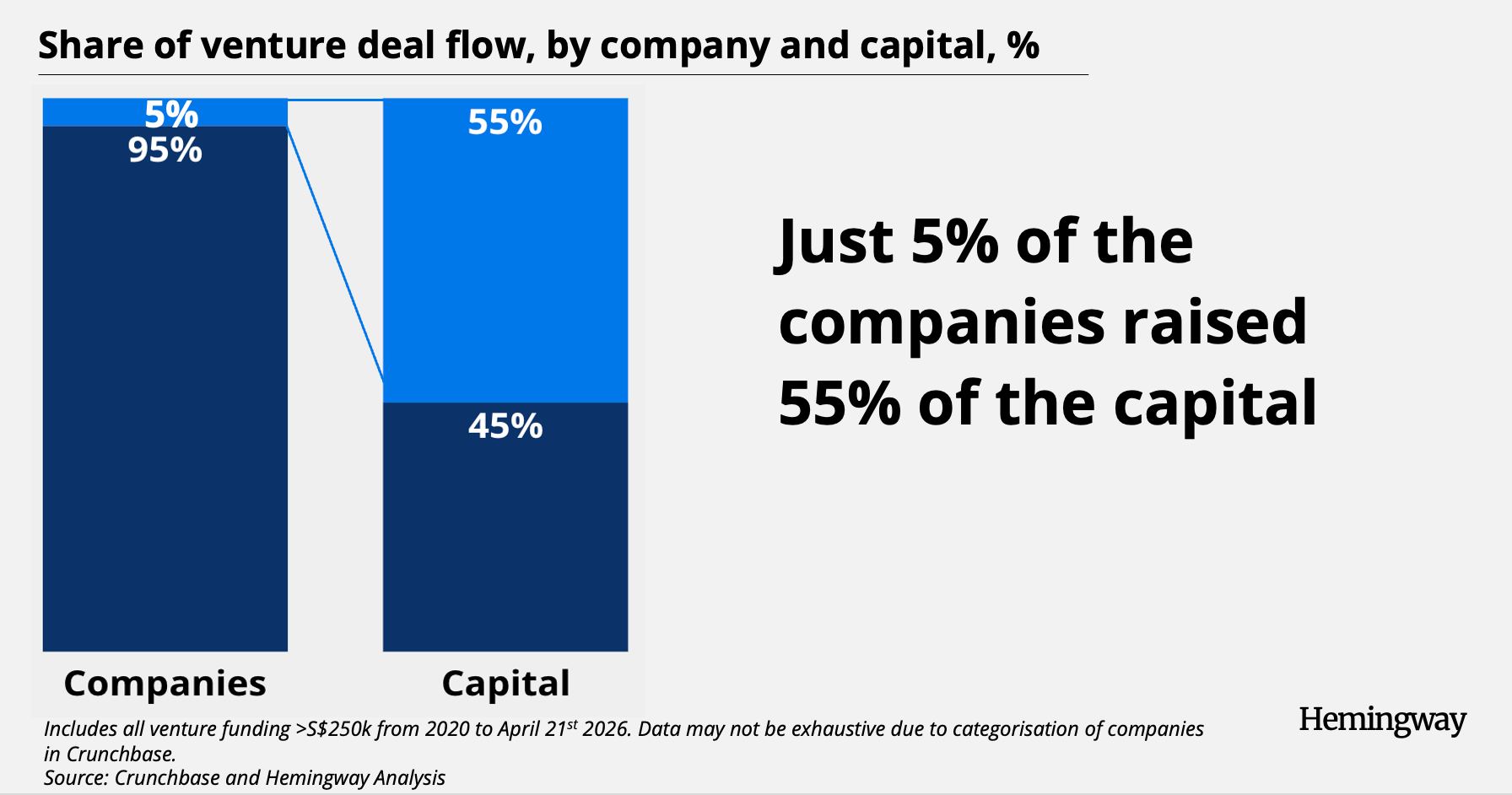
The answer to last week’s chart was: “The Allocation of Venture Capital to Mental Health Startups”. Since 2020, 55% of all venture funding has gone to the top 5% of mental health startups, with 5 companies (Talkiatry, Spring, Cerebral, Lyra and Headway) responsible for 26% of all capital. Data is as of 21st April 2026. While it’s not unusual to see power law capital allocation profiles like this in venture markets, it’s a reminder to look beyond headline numbers of capital flow to be able to understand which companies (and how many of them) are actually getting funded.